- Biology & Life
- Tech & Engineering
Hacking Biology for Nanotechnology
Nature is a master of nanotechnology; the structures and machines of the living world are far more sophisticated than any existing synthetic structure. These arose through evolution, a trial and error search that, in the course of billions of years, has discovered how to organize simple molecular “building blocks” into functional units that allow organisms to succeed at their goals of survival and reproduction. We would like to find optimal nano-materials and structures to achieve our own (not-necessarily biological) objectives, but without having to spend billions of years developing them.
In this course, we will explore the vast chemical interaction space of the biological world, which harbors countless molecular structures of potential use to us. We’ll see that it is increasingly possible to create and design new technologies by rearranging existing biomolecules into new structures, which are discovered through a combination of experiments and simulations. These nanostructure have functionality including disease detection, actuators for soft robots, and devices that seamlessly integrate with the human body — all built on top of the existing biochemical building blocks found throughout life.
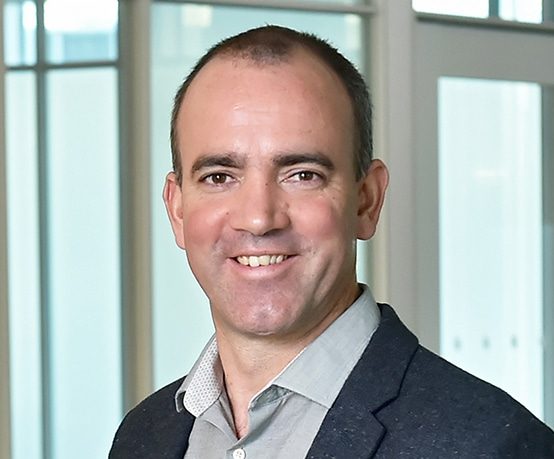
Rein Ulijn
Rein Ulijn is the founding director of the Nanoscience Initiative at the Advanced Science Research Center at The Graduate Center of the City University of New York. He was previously professor and vice dean of research at the University of Strathclyde in Glasgow, Scotland, where he continues to hold a position. Prior to this, he started his independent career at the University of Manchester. His education was from the University of Wageningen, Netherlands (M.Sc. biotechnology), Strathclyde (Ph.D. physical chemistry), Edinburgh (postdoc in chemistry). He has held several personal fellowships and won a number of awards, including the RSC Norman Heatley Medal and Royal Society Wolfson Merit Award. He was elected to the Fellowship of the Royal Society of Edinburgh (Scotland’s national academy of science) in 2014.